On March 11th, a federal appeals court ruled that the inclusion of the phrase “one nation under God” in the Pledge of Allegiance does not violate the Establishment Clause of the 1st Amendment to the US Constitution. At first glance, this appears to be a victory for Christians in America. However, when the ruling is read in its entirety, it should actually serve as a wakeup call.
The court’s decision was made based on the interpretation that including the phrase “under God” did not promote any specific religion or deity, but merely emphasized the idea that humans have inalienable rights. In this and similar cases, such as including the phrase, “In God We Trust” on our currency, the courts have argued that it is not promoting any particular religion because it can refer to any ‘god’, not necessarily the Christian one. The argument reminds us of the ancient Greeks who worshiped a deity they called Agnostos Theos, that is: the unknown god. In Acts 17, Paul proclaims to the believers in “the unknown God”: “Now what you worship as something unknown I am going to proclaim to you. The God who made the world and everything in it is the Lord of heaven and earth” (Acts 17:22-23).
As Christians, we do not worship a God who is merely a concept, precept, or abstract idea. We worship the Lord of Heaven and Earth who became incarnate as Jesus Christ. Over the past century, in our zeal to avoid offending anyone with our specific beliefs, we have pedaled a generic god instead of proclaiming the good news of the one true God. Ironically, in our attempts protect God, (as if he needed anything from us), we have diminished the power of our testimony to mere platitudes, moral laws and fuzzy images. As a result, Christianity may win the battle of being respectable in our culture, but lose the war of saving souls for Jesus Christ. If we continue down this path, Christianity will be irrelevant for anything except political pageantry.
The true battle that needs to be fought has nothing to do with meditation times in school, inscriptions on coins, pledges, or any other mandate of Congress. The true battle is how we witness to our specific faith in God the Father, Son, and Holy Spirit. It is not as important that teachers lead prayers in school as it is that we teach kids to pray by our example. It doesn’t matter as much what is written on our coins as much as how we use our money in ways that honor God. It is not the words that we use in our pledges as much as the actions that we live out as disciples of Jesus Christ that will snatch souls from the devil. When we move from talking about ‘god’ to sharing the good news of Christ’s resurrection from the dead, some will sneer. But others will say, “We want to hear you again on this subject” (Acts 17:32). The battle will be won in the hearts of individuals, not in the chambers of the courts.
Grace and Peace,
Rev. Karl Sokol
Monday, June 28, 2010


Tuesday, January 26, 2010
Gloria a Dios, Su Reino Está Aquí: The Prophetic Voice of the Hispanic Experience of the United Methodist Church in The United States
“You can try and teach us what us what you think the scripture says, and we will listen. We can teach you how to live the scripture. Will you listen?”1
Making up just a small percentage of The United Methodist Church (00.4 %), the Hispanic community of believers offers significant gifts and challenges to the denomination.2 There are about 17 Latino churches in the Northern Illinois conference that have Latino pastors and a Latino majority in the pew. They are traditionally small. Five Latino families can make up a congregation. Yet, on the one hand, they possess rich cultural and religious traditions that can inform the ways in which we do church. On the other, the systematic discrimination that is committed against Spanish-speaking immigrants and their descendants in the Unites States gives them a privileged vantage point from which to see the Kingdom of God.3 Following the leads that the Hispanic community demonstrates in dealing with social justice issues, we can better learn how to be church. Therefore, it is essential that the greater church look at ways to ensure the health of the Hispanic United Methodist community, as well as open itself to the gifts of transformation that it offers.
The religious tradition of the Hispanic community is composed of two strands. The first is Roman Catholicism, which is the most predominant faith of people in Mexico and South America, as well as amongst Latin Americans living in the States. The Hispanic flavor of Catholicism tends to be focused on ritual observances, mystery, the Saints, and Mary. As a result, members at Humboldt Park United Methodist Church, El Divino Redentor United Methodist Church and Adalberto United Methodist Church all cited a co-involvement with local Catholic Churches. Walter L. Coleman, Senior pastor at Adalberto commented, “Sometimes you come in here and you'll see the place is filled up out to the streets. This has usually been when we're doing something around the Virgin Mother. And this summer we haven't really had Sunday service because we've been spreading out throughout all the Catholic churches doing various different things with them.”4
Just as the Wesleys did not particularly want to stray too far from the Anglican Church, but rather be a reform movement within it, many Hispanic United Methodists have an elective affinity with the Catholic Church. Coleman notes, “What we have seen is in one sense spiritual discipline, intentional groups and such things combined with the very concept of sanctification and justification and social principles [which is] an overlay that works well on the Catholic Church. So, the mission and our reach are done in terms of Catholic Churches.”5 For all of its similarities to American Catholicism, though, the Latino American Methodist Church is a Mexican Catholic culture. According to Colman, “We see a lot of Mexicans and Puerto Ricans who have left the Catholic Church because the traditions are foreign to them compared to what they were like in their own country. The Catholic experience in the United States is as different to the Catholic experience in Mexico as it is from United Methodism.”6
Yet, by nature of their general economic status, there is also a similarity between Hispanic United Methodist’s and many of Wesley's initial followers, offering a renewal within United Methodism as well. “The Anglican Church is not very much different than the United Methodist Church today. You could imagine the church---a great big church with mostly middle-class folks and most of the seats are empty but they have an organ and stuff like that. Then some pastor wakes up next-door and sees 3000 guys from the local factories that want communion. And he must have been, like, you want me to get up and give communion to a bunch of dirty guys?”7 Needless to say, the similarity does not offer a favorable representation of United Methodism. Maria De La Cruz, a member of Adalberto, repeated this message. “So many pastors go from their middle class church to their middle class car and into their middle class house and they never see any day-to-day realities that the Latino community lives with. So the Latino community would challenge them to get out of their comfort zone to experience what it would be like to be one of their Latin American brothers and sisters.” She went on to observe, “With a grass root reality of what it is like to be with these people comes an experience of what it is like to be in the Kingdom of God. To realize that there are people in the Latino community who do not have anything to eat every day. What does that do to our Gospel of being brothers and sisters in Christ all across race boundaries.” 8 The economic status of our Hispanic brothers and sisters should shake us from our comfortable complacency and renew our social activist heritage, as well as reawaken our enthusiasm for worship. I attended three services, for a total of ten hours, with every minute of each one being engaging. Instead of sermons on how to be polite, I was inundated with images like “the horseman of the apocalypse is galloping up Division St. as we speak!” and given mandates on how to spend my money justly, and my Christian duty to participate in a large variety of causes from immigration law to protesting the wars.
When asked about the Hispanic United Methodist experience, two church members mentioned that for many Mexican-Americans who have been in this country their whole lives, they simply attend the mainstream United Methodist churches, bringing only cosmetic changes (such as the occasional Mexican song in service). These Latinos reportedly tend to be more liberal in their interpretation of the gospel and church doctrines. Pastor Coleman believes that there is a Methodist tradition from Latin America, which is more ‘evangelical’. Within this group, he cites a tension between those who are progressive, (e.g. Bishop Juan Vera Mendez of the Puerto Rico conference “which is both spiritual and socially active.)”9 And the more rapidly growing ‘Pentecostal’ movement of churches supported by “United States corporations who have wanted missions down there” and who “tend to be what we call American Zionism.”10 Although the latter is (an unfortunate) part of our heritage, the United Methodist Church officially broke from the idea that this nation was somehow chosen by God. Nonetheless, the former group offers the greatest challenge to how the church views itself. As several million more people enter this country, many whom see the US as their oppressor, the United Methodist church will have to clarify its stance even more. One voice is coming from Emma Lozano who, at a consultation on immigration ministry held at Garrett Evangelical Theological Seminary last year, charged the religious community to legalize undocumented workers and be consistent with the stand that we took in Bosnia, Liberia, Rwanda, and Kosovo, in our own back yard.11 Another witness is coming from Adalberto United Methodist Church, which has developed community services such as a Latino Parent Teachers Association in the Chicago area, a utility bill ministry, organized 100 congregations to speak out against the impending War in Iraq and, like many Latino United Methodist are active in immigration rights.12 13 14 According to deacon Eduardo Hernandez, churches like El Divino Redentor in Chicago provide the service of bridging the cultural rift that exists between natives of Latin America and their American born decedents. In 1998 Chicago, Iglesia Methodist Unida Betania administered a $19,000 grant to the Bethany/Adalberto Immigrant Defense Fund.15 In addition to the mission work that individual Latino congregations are doing, groups like Methodists Associated Representing the Cause of Hispanic Americans (MARCHA), which has had agendas as diverse as establishing churches to demanding an apology for the arrogance of 19th c. Methodist Missionaries to Latin America, are making important advances. MARCHA was also influential in promoting The Council of Bishops to recognize the “Sojourners in Our Midst” “who find themselves in a country whose language they do not speak, whose immigration policies declare them illegal.”16
On the other hand, the “Pentecostal” trend, according to Coleman, “thinks that God is working nearly exclusively through the United States. This is the history of the institutional church, but it is more blatant when it is exported to Latin America and back again.” This trend demonstrates the fragile nature of a dominant group helping to establish a minority in its midst.
This is in part why it is essential that the future of the Latino church is motivated and sustained by a new generation of preachers from its own community. Unfortunately, there are several obstacles that must be faced to accomplish this, not least of which is funding. Recognizing the difficulties faced by minorities that are in a traditionally low-income demographic (as well as other factors that only allow the privileged to attend school), the General Board of Higher Education and Ministry (GBHEM) offers an alternative tract for individuals “who are certified candidates for ordained ministry, who have successfully completed the Studies for License as a Local Pastor or one-third of their work for a master of divinity degree, who have been licensed by the bishop after approval by the district Committee and Board of Ordained Ministry, and are unable to attend an approved school of theology” which would allow them to become ordained as elders.17 GBHEM underwrites both the tuition and the transportation costs for about 150 students to attend Garrett-Evangelical, one of only three schools were this program is available in Spanish, each summer to go to this “Course of Study” (COS) program. This, and the fact that the Board of Trustees of Garrett-Evangelical established the Center for Hispanic Ministries in 1988 “In response to the urgent need for more ordained and diaconal leaders for churches in the Hispanic community” are encouraging signs that the seminary is part of a prophetic movement to enfranchise the Latino community within United Methodism.18 However, the success of the center in achieving its stated goal to bring “Hispanic culture and experience into the life of the seminary” is debatable. The unfortunate reality is that there has not been a single Latino students enrolled in one of the Masters programs at Garrett-Evangelical for at least two years. This is significant because, not only is the quality of the education arguably less extensive through the COS tract, it can take seven years for enrollees to become a local pastor.19 This puts the individual in a precarious situation, since they are not guaranteed a position, they cannot vote at conference, and are not guaranteed their pension. Furthermore, if they do lose their post in the church, they would not have an accredited degree that would be recognized outside of the church.
There is a certain level of commitment by the church to support future leaders within the Hispanic community. For example, The North Georgia conference is supporting A Leadership Development Program for Hispanic Students called LAOS — "Latinos on to serve": which includes full tuition (plus stipends) to the undergraduate program at Reinhardt College.20 Also, one member of Adalberto United Methodist Church believes that he will be accepted to Garrett-Evangelical next year on a full scholarship. However, Whether the Latino community will have adequate ‘native’ clergy leadership in the future is not limited to financial issues. Those families that are fortunate enough to be able to support their child through seminary face the challenge of maintaining a cultural link. As Minerva Carcaño notes, leaving home for college can also mean, “adopting new and different lifestyles. It even could mean losing the language.” Furthermore, “There is no cultural support system and they are cut off from their families and communities.” Over time, this disconnect may result in the student not returning to the community after they graduate.21
It is essential that we work out creative ways to overcome obstacles that face Hispanic United Methodists called to ministry. We must be able to “read the signs of the times and discern ways to enable diverse people…to experience the riches of tradition that are this denomination’s precious gifts.”22 As the demographics of this country change and the majority of its citizens come from Africa, the Middle East or Latin America, it will be increasingly tempting for the Anglo culture to attempt to colonize or annex a church just because we built the building and Latinos happen to be there. As Ruben Saenz reminds us, “We must be careful that our motivation for evangelizing the Hispanic community is not born out of a need to sustain the institution nor should it be done out of xenophobia…”.23 There is always the danger of making these churches “in the role of being objects of mission and not as being part of the national church.”24 Instead, we need to remind ourselves of Wesley's vision of renewal. The United Methodist Church has become an institution with privilege. Yet, God has proven himself in Christ and the cross with a very different model. By allowing the Hispanic United Methodist Church to inform our theology and way of doing church “from the underside,” we can be a more genuine witness to the Gospel. But as long the delegates to our annual conference meetings are 97 percent English-speaking and white, we are constantly at risk of falling. The problem before us in this next century is to seek the balance between co-opting, like we have in our missionary history, and segregating, like the white Methodists did to their African-American sisters and brothers. Nonetheless, “Would we not be more likely to find a happier and more Christian solution to these questions if we approached them not from the standpoint of problems but from the standpoint of opportunities?”25
May the church be a vehicle for Christ Jesus to do his Abba’s work through the Holy Spirit. Amen.
1. Betti Guevera, Asst Pastor of Iglesia Metodista Unida Adalberto. Personal interview. 22 Sep. 2002.
2. According to figures collected for the 1996 General Conference, Hispanic members comprise 42,797 out of a total membership of 8,654,699. http://www.umc.org/genconf/struct.html
3. Although there are significant numbers of economically ‘successful’ Hispanic immigrants, especially in Texas, nearly a third (27.9) lived in poverty (compared to 8.6 percent of non-Hispanic whites) in 1997. Improving the Collection and Use of Racial and Ethnic Data in HHS: Joint Report of the HHS Data Council Working Group on Racial and Ethnic Data AND The Data Work Group of the HHS Initiative to Eliminate Racial and Ethnic Disparities in Health. December, 1999. page 2. http://aspe.os.dhhs.gov/datacncl/racerpt/
4. Walter L. Coleman. Pastor of Iglesia Metodista Unida Adalberto Personal interview. 23 Nov. 2002.
5. Ibid.
6. Ibid.
7. Ibid.
8. Maria De La Cruz. Personal interview in Spanish. Trans. by Teran Loepke. 22 Sep. 2002.
9. Coleman
10. Ibid.
11. Michael Wacht. “Hispanic Methodists tackle justice issues at assembly”. General Board of Global Ministries Archives. Nov 28, 2001. http://gbgm-umc.org/global_news/full_article.cfm?articleid=680
12. Personal e-mail: “Testigo En Contra De La Guerra”. 20 Oct. 2002.
13. “Bishops award 31 Children and Poverty grants” United Methodist News Service Feb. 27, 2002
14. Newsletter. Illinois Coalition for Immigrant and Refugee Rights. http://www.icirr.org/newsandaction/PressReleaseInterfaithimmigranteventforWTC.htm
15. http://umns.umc.org/98/mar/123.htm
16. Alice Lucy Cobb. A Tapestry of Service: 100 Plus Years Along the Way in Church and Community Ministry. 2nd ed. (J & J Printers; Nashville, 1999). 87.
17. Jim Noseworthy. Handbook for Ordination, Ch 11. (Division of Higher Education). 1996. http://www.gbhem.org/gbhem/chap11.htm
18. Osvaldo Vena. Informational pamphlet for Center for Hispanic Ministries.
19. This comparison between COS and MDiv in no way reflects on the capabilities of Rex Piercy and Melissa Guerin!
20. http://www.gbod.org/hispanic/articles.asp?act=reader&item_id=2993
21. “Observations from the African-American, Hispanic-American, and European American
Perspectives”. Brief notes from a panel discussion by Daphne Wiggins, Minerva Carcaño and
Richard Boyer. Doing Ministry on Campus with People of Color: Resources for Intervention in Higher Education. Hicks, Richard ed. Published by the Campus Ministry Section, Division of Higher Education, United Methodist Board of Higher Education, 1991.
22. Thomas E. Frank. Polity, Practice and the Mission of the United Methodist Church . (Abingdon; Nashville, 1997). Page 28.
23. Ruben Saenz Jr. “Evngelism within the Hispanic Community: A Complex Calling.” Circuit Rider Nov/Dec 2002.
24. Celsa Garrastegui. “Hispanic Women Want No Melting Pot.” The Methodist Experience in America vol II. Ed. Russell E. Richey et al. (Abingdon; Nashville, 2000). Page 648.
25. Methodism’s Racial Dilemna. James S. Thomas. (Abingdon: Nashville. 1992). Page. 80.
Making up just a small percentage of The United Methodist Church (00.4 %), the Hispanic community of believers offers significant gifts and challenges to the denomination.2 There are about 17 Latino churches in the Northern Illinois conference that have Latino pastors and a Latino majority in the pew. They are traditionally small. Five Latino families can make up a congregation. Yet, on the one hand, they possess rich cultural and religious traditions that can inform the ways in which we do church. On the other, the systematic discrimination that is committed against Spanish-speaking immigrants and their descendants in the Unites States gives them a privileged vantage point from which to see the Kingdom of God.3 Following the leads that the Hispanic community demonstrates in dealing with social justice issues, we can better learn how to be church. Therefore, it is essential that the greater church look at ways to ensure the health of the Hispanic United Methodist community, as well as open itself to the gifts of transformation that it offers.
The religious tradition of the Hispanic community is composed of two strands. The first is Roman Catholicism, which is the most predominant faith of people in Mexico and South America, as well as amongst Latin Americans living in the States. The Hispanic flavor of Catholicism tends to be focused on ritual observances, mystery, the Saints, and Mary. As a result, members at Humboldt Park United Methodist Church, El Divino Redentor United Methodist Church and Adalberto United Methodist Church all cited a co-involvement with local Catholic Churches. Walter L. Coleman, Senior pastor at Adalberto commented, “Sometimes you come in here and you'll see the place is filled up out to the streets. This has usually been when we're doing something around the Virgin Mother. And this summer we haven't really had Sunday service because we've been spreading out throughout all the Catholic churches doing various different things with them.”4
Just as the Wesleys did not particularly want to stray too far from the Anglican Church, but rather be a reform movement within it, many Hispanic United Methodists have an elective affinity with the Catholic Church. Coleman notes, “What we have seen is in one sense spiritual discipline, intentional groups and such things combined with the very concept of sanctification and justification and social principles [which is] an overlay that works well on the Catholic Church. So, the mission and our reach are done in terms of Catholic Churches.”5 For all of its similarities to American Catholicism, though, the Latino American Methodist Church is a Mexican Catholic culture. According to Colman, “We see a lot of Mexicans and Puerto Ricans who have left the Catholic Church because the traditions are foreign to them compared to what they were like in their own country. The Catholic experience in the United States is as different to the Catholic experience in Mexico as it is from United Methodism.”6
Yet, by nature of their general economic status, there is also a similarity between Hispanic United Methodist’s and many of Wesley's initial followers, offering a renewal within United Methodism as well. “The Anglican Church is not very much different than the United Methodist Church today. You could imagine the church---a great big church with mostly middle-class folks and most of the seats are empty but they have an organ and stuff like that. Then some pastor wakes up next-door and sees 3000 guys from the local factories that want communion. And he must have been, like, you want me to get up and give communion to a bunch of dirty guys?”7 Needless to say, the similarity does not offer a favorable representation of United Methodism. Maria De La Cruz, a member of Adalberto, repeated this message. “So many pastors go from their middle class church to their middle class car and into their middle class house and they never see any day-to-day realities that the Latino community lives with. So the Latino community would challenge them to get out of their comfort zone to experience what it would be like to be one of their Latin American brothers and sisters.” She went on to observe, “With a grass root reality of what it is like to be with these people comes an experience of what it is like to be in the Kingdom of God. To realize that there are people in the Latino community who do not have anything to eat every day. What does that do to our Gospel of being brothers and sisters in Christ all across race boundaries.” 8 The economic status of our Hispanic brothers and sisters should shake us from our comfortable complacency and renew our social activist heritage, as well as reawaken our enthusiasm for worship. I attended three services, for a total of ten hours, with every minute of each one being engaging. Instead of sermons on how to be polite, I was inundated with images like “the horseman of the apocalypse is galloping up Division St. as we speak!” and given mandates on how to spend my money justly, and my Christian duty to participate in a large variety of causes from immigration law to protesting the wars.
When asked about the Hispanic United Methodist experience, two church members mentioned that for many Mexican-Americans who have been in this country their whole lives, they simply attend the mainstream United Methodist churches, bringing only cosmetic changes (such as the occasional Mexican song in service). These Latinos reportedly tend to be more liberal in their interpretation of the gospel and church doctrines. Pastor Coleman believes that there is a Methodist tradition from Latin America, which is more ‘evangelical’. Within this group, he cites a tension between those who are progressive, (e.g. Bishop Juan Vera Mendez of the Puerto Rico conference “which is both spiritual and socially active.)”9 And the more rapidly growing ‘Pentecostal’ movement of churches supported by “United States corporations who have wanted missions down there” and who “tend to be what we call American Zionism.”10 Although the latter is (an unfortunate) part of our heritage, the United Methodist Church officially broke from the idea that this nation was somehow chosen by God. Nonetheless, the former group offers the greatest challenge to how the church views itself. As several million more people enter this country, many whom see the US as their oppressor, the United Methodist church will have to clarify its stance even more. One voice is coming from Emma Lozano who, at a consultation on immigration ministry held at Garrett Evangelical Theological Seminary last year, charged the religious community to legalize undocumented workers and be consistent with the stand that we took in Bosnia, Liberia, Rwanda, and Kosovo, in our own back yard.11 Another witness is coming from Adalberto United Methodist Church, which has developed community services such as a Latino Parent Teachers Association in the Chicago area, a utility bill ministry, organized 100 congregations to speak out against the impending War in Iraq and, like many Latino United Methodist are active in immigration rights.12 13 14 According to deacon Eduardo Hernandez, churches like El Divino Redentor in Chicago provide the service of bridging the cultural rift that exists between natives of Latin America and their American born decedents. In 1998 Chicago, Iglesia Methodist Unida Betania administered a $19,000 grant to the Bethany/Adalberto Immigrant Defense Fund.15 In addition to the mission work that individual Latino congregations are doing, groups like Methodists Associated Representing the Cause of Hispanic Americans (MARCHA), which has had agendas as diverse as establishing churches to demanding an apology for the arrogance of 19th c. Methodist Missionaries to Latin America, are making important advances. MARCHA was also influential in promoting The Council of Bishops to recognize the “Sojourners in Our Midst” “who find themselves in a country whose language they do not speak, whose immigration policies declare them illegal.”16
On the other hand, the “Pentecostal” trend, according to Coleman, “thinks that God is working nearly exclusively through the United States. This is the history of the institutional church, but it is more blatant when it is exported to Latin America and back again.” This trend demonstrates the fragile nature of a dominant group helping to establish a minority in its midst.
This is in part why it is essential that the future of the Latino church is motivated and sustained by a new generation of preachers from its own community. Unfortunately, there are several obstacles that must be faced to accomplish this, not least of which is funding. Recognizing the difficulties faced by minorities that are in a traditionally low-income demographic (as well as other factors that only allow the privileged to attend school), the General Board of Higher Education and Ministry (GBHEM) offers an alternative tract for individuals “who are certified candidates for ordained ministry, who have successfully completed the Studies for License as a Local Pastor or one-third of their work for a master of divinity degree, who have been licensed by the bishop after approval by the district Committee and Board of Ordained Ministry, and are unable to attend an approved school of theology” which would allow them to become ordained as elders.17 GBHEM underwrites both the tuition and the transportation costs for about 150 students to attend Garrett-Evangelical, one of only three schools were this program is available in Spanish, each summer to go to this “Course of Study” (COS) program. This, and the fact that the Board of Trustees of Garrett-Evangelical established the Center for Hispanic Ministries in 1988 “In response to the urgent need for more ordained and diaconal leaders for churches in the Hispanic community” are encouraging signs that the seminary is part of a prophetic movement to enfranchise the Latino community within United Methodism.18 However, the success of the center in achieving its stated goal to bring “Hispanic culture and experience into the life of the seminary” is debatable. The unfortunate reality is that there has not been a single Latino students enrolled in one of the Masters programs at Garrett-Evangelical for at least two years. This is significant because, not only is the quality of the education arguably less extensive through the COS tract, it can take seven years for enrollees to become a local pastor.19 This puts the individual in a precarious situation, since they are not guaranteed a position, they cannot vote at conference, and are not guaranteed their pension. Furthermore, if they do lose their post in the church, they would not have an accredited degree that would be recognized outside of the church.
There is a certain level of commitment by the church to support future leaders within the Hispanic community. For example, The North Georgia conference is supporting A Leadership Development Program for Hispanic Students called LAOS — "Latinos on to serve": which includes full tuition (plus stipends) to the undergraduate program at Reinhardt College.20 Also, one member of Adalberto United Methodist Church believes that he will be accepted to Garrett-Evangelical next year on a full scholarship. However, Whether the Latino community will have adequate ‘native’ clergy leadership in the future is not limited to financial issues. Those families that are fortunate enough to be able to support their child through seminary face the challenge of maintaining a cultural link. As Minerva Carcaño notes, leaving home for college can also mean, “adopting new and different lifestyles. It even could mean losing the language.” Furthermore, “There is no cultural support system and they are cut off from their families and communities.” Over time, this disconnect may result in the student not returning to the community after they graduate.21
It is essential that we work out creative ways to overcome obstacles that face Hispanic United Methodists called to ministry. We must be able to “read the signs of the times and discern ways to enable diverse people…to experience the riches of tradition that are this denomination’s precious gifts.”22 As the demographics of this country change and the majority of its citizens come from Africa, the Middle East or Latin America, it will be increasingly tempting for the Anglo culture to attempt to colonize or annex a church just because we built the building and Latinos happen to be there. As Ruben Saenz reminds us, “We must be careful that our motivation for evangelizing the Hispanic community is not born out of a need to sustain the institution nor should it be done out of xenophobia…”.23 There is always the danger of making these churches “in the role of being objects of mission and not as being part of the national church.”24 Instead, we need to remind ourselves of Wesley's vision of renewal. The United Methodist Church has become an institution with privilege. Yet, God has proven himself in Christ and the cross with a very different model. By allowing the Hispanic United Methodist Church to inform our theology and way of doing church “from the underside,” we can be a more genuine witness to the Gospel. But as long the delegates to our annual conference meetings are 97 percent English-speaking and white, we are constantly at risk of falling. The problem before us in this next century is to seek the balance between co-opting, like we have in our missionary history, and segregating, like the white Methodists did to their African-American sisters and brothers. Nonetheless, “Would we not be more likely to find a happier and more Christian solution to these questions if we approached them not from the standpoint of problems but from the standpoint of opportunities?”25
May the church be a vehicle for Christ Jesus to do his Abba’s work through the Holy Spirit. Amen.
1. Betti Guevera, Asst Pastor of Iglesia Metodista Unida Adalberto. Personal interview. 22 Sep. 2002.
2. According to figures collected for the 1996 General Conference, Hispanic members comprise 42,797 out of a total membership of 8,654,699. http://www.umc.org/genconf/struct.html
3. Although there are significant numbers of economically ‘successful’ Hispanic immigrants, especially in Texas, nearly a third (27.9) lived in poverty (compared to 8.6 percent of non-Hispanic whites) in 1997. Improving the Collection and Use of Racial and Ethnic Data in HHS: Joint Report of the HHS Data Council Working Group on Racial and Ethnic Data AND The Data Work Group of the HHS Initiative to Eliminate Racial and Ethnic Disparities in Health. December, 1999. page 2. http://aspe.os.dhhs.gov/datacncl/racerpt/
4. Walter L. Coleman. Pastor of Iglesia Metodista Unida Adalberto Personal interview. 23 Nov. 2002.
5. Ibid.
6. Ibid.
7. Ibid.
8. Maria De La Cruz. Personal interview in Spanish. Trans. by Teran Loepke. 22 Sep. 2002.
9. Coleman
10. Ibid.
11. Michael Wacht. “Hispanic Methodists tackle justice issues at assembly”. General Board of Global Ministries Archives. Nov 28, 2001. http://gbgm-umc.org/global_news/full_article.cfm?articleid=680
12. Personal e-mail: “Testigo En Contra De La Guerra”. 20 Oct. 2002.
13. “Bishops award 31 Children and Poverty grants” United Methodist News Service Feb. 27, 2002
14. Newsletter. Illinois Coalition for Immigrant and Refugee Rights. http://www.icirr.org/newsandaction/PressReleaseInterfaithimmigranteventforWTC.htm
15. http://umns.umc.org/98/mar/123.htm
16. Alice Lucy Cobb. A Tapestry of Service: 100 Plus Years Along the Way in Church and Community Ministry. 2nd ed. (J & J Printers; Nashville, 1999). 87.
17. Jim Noseworthy. Handbook for Ordination, Ch 11. (Division of Higher Education). 1996. http://www.gbhem.org/gbhem/chap11.htm
18. Osvaldo Vena. Informational pamphlet for Center for Hispanic Ministries.
19. This comparison between COS and MDiv in no way reflects on the capabilities of Rex Piercy and Melissa Guerin!
20. http://www.gbod.org/hispanic/articles.asp?act=reader&item_id=2993
21. “Observations from the African-American, Hispanic-American, and European American
Perspectives”. Brief notes from a panel discussion by Daphne Wiggins, Minerva Carcaño and
Richard Boyer. Doing Ministry on Campus with People of Color: Resources for Intervention in Higher Education. Hicks, Richard ed. Published by the Campus Ministry Section, Division of Higher Education, United Methodist Board of Higher Education, 1991.
22. Thomas E. Frank. Polity, Practice and the Mission of the United Methodist Church . (Abingdon; Nashville, 1997). Page 28.
23. Ruben Saenz Jr. “Evngelism within the Hispanic Community: A Complex Calling.” Circuit Rider Nov/Dec 2002.
24. Celsa Garrastegui. “Hispanic Women Want No Melting Pot.” The Methodist Experience in America vol II. Ed. Russell E. Richey et al. (Abingdon; Nashville, 2000). Page 648.
25. Methodism’s Racial Dilemna. James S. Thomas. (Abingdon: Nashville. 1992). Page. 80.
Tuesday, March 13, 2007
carl thomas gladstone
I was outside, enjoying the ridiculously nice weather, when my old pal Carl Thomas Gladstone called. He mentioned about me being on his rather excellent podcast, and sure enough, I'm right there on the 'ol Christmas post working with him on a rather funky track based on the book of Habakkuk. I don't have this exact recording, so it was nice to hear it. I'm a little embarrassed about how I get my Jimmy Swaggart on toward the end there, but otherwise it is enjoyable prophetic music with a summery (if not Christmassy) edge.
Check it out under Storyteller #13 While your there, listen to the tons of superior CTG solo stuff.
Check it out under Storyteller #13 While your there, listen to the tons of superior CTG solo stuff.
Thursday, March 01, 2007
Temptation
Temptation properly defined is “settling for less”. Temptation is settling for less. That is the human condition. The second chapter of Genesis, with the Adam and Eve story, is a story about temptation, right. If you brought your swords with you, open to Genesis 2 with me. God created a paradise for these two ancestors of ours, but in the midst of this paradise was a tree.
In Chapter 2, vs. 3 we read that God did say, 'You must not eat fruit from the tree that is in the middle of the garden, and you must not touch it, or you will die.'
And then the serpent, commonly understood in our tradition to be Satan, comes up with a counter argument. A better idea than God's plan.
4 You will not surely die, the serpent said to the woman. 5 For God knows that when you eat of it your eyes will be opened, and you will be like God, knowing good and evil.
Here's a tip for you to pass on to your children and grand-children: if you think that you know better than God, you don't. Sounds obvious but how often do we ignore it. How often do we 'settle for less' than the abundant life that God planned for us?
And then what does she do? In vs 6. we read,
“When the woman saw that the fruit of the tree was good for food and pleasing to the eye, and also desirable for gaining wisdom, she took some and ate it. She also gave some to her husband, who was with her, and he ate it.”
Let's be honest, most of the published theology in the history of the church has been by men. So, it is no surprise that Eve has gotten most of the blame throughout the ages. Well, this is one of those times when we need to reach past the tradition and go straight to the Scriptures, Eve didn't strap Adam down and put a feeding tube in his mouth. Adam was a big boy. He could make his own decisions. Whenever you see this story portrayed, whether it be Bette Davis on the Bergan and McCarthy radio program where she invents “apple sauce”, or in Milton's Paradise Lost where she has psychic control over poor Adam, or in the thousands of Renaissance artists who were looking for a respectable excuse for painting naked people, or in the way my own Sunday School teacher taught the story, we always have a reluctant Adam saying, “I don't know about this.” And Eve finally seducing him. But, as we just read, the Scriptures say, “She gave some to her husband, and he ate it.”
For that matter, the serpent probably gets too much credit from the narrator of the story as being “more crafty than any of the wild animals the LORD God had made”. It's not like he came up with a particularly clever argument. He didn't go to much effort to prove his (or her) statements. Just said, “oh it's O.K., God doesn't want what's best for you.” And then Adam and Eve succumbed to this pathetic excuse for a temptation. They settled for less than what God intended. Way less!
The could have taken the Nancy Reagan route. When a group of students asked her how they could remain drug-free, she replied, "Just say No!" Now, even though, when that became extrapolated into a national policy of a “Drug War” it ended up causing more harm than good, the truth of the comment remained, "Just Say No". On the personal level, the Bible makes it clear that we can resist temptation and sin by just saying No! Adam and Eve could have just said no, I want life and I want it abundantly. Snakes do not have better ideas than God.
Let's stop thinking of resisting temptation as depriving us from something that we want, and instead recognize it as merely settling for less!
In Chapter 2, vs. 3 we read that God did say, 'You must not eat fruit from the tree that is in the middle of the garden, and you must not touch it, or you will die.'
And then the serpent, commonly understood in our tradition to be Satan, comes up with a counter argument. A better idea than God's plan.
4 You will not surely die, the serpent said to the woman. 5 For God knows that when you eat of it your eyes will be opened, and you will be like God, knowing good and evil.
Here's a tip for you to pass on to your children and grand-children: if you think that you know better than God, you don't. Sounds obvious but how often do we ignore it. How often do we 'settle for less' than the abundant life that God planned for us?
And then what does she do? In vs 6. we read,
“When the woman saw that the fruit of the tree was good for food and pleasing to the eye, and also desirable for gaining wisdom, she took some and ate it. She also gave some to her husband, who was with her, and he ate it.”
Let's be honest, most of the published theology in the history of the church has been by men. So, it is no surprise that Eve has gotten most of the blame throughout the ages. Well, this is one of those times when we need to reach past the tradition and go straight to the Scriptures, Eve didn't strap Adam down and put a feeding tube in his mouth. Adam was a big boy. He could make his own decisions. Whenever you see this story portrayed, whether it be Bette Davis on the Bergan and McCarthy radio program where she invents “apple sauce”, or in Milton's Paradise Lost where she has psychic control over poor Adam, or in the thousands of Renaissance artists who were looking for a respectable excuse for painting naked people, or in the way my own Sunday School teacher taught the story, we always have a reluctant Adam saying, “I don't know about this.” And Eve finally seducing him. But, as we just read, the Scriptures say, “She gave some to her husband, and he ate it.”
For that matter, the serpent probably gets too much credit from the narrator of the story as being “more crafty than any of the wild animals the LORD God had made”. It's not like he came up with a particularly clever argument. He didn't go to much effort to prove his (or her) statements. Just said, “oh it's O.K., God doesn't want what's best for you.” And then Adam and Eve succumbed to this pathetic excuse for a temptation. They settled for less than what God intended. Way less!
The could have taken the Nancy Reagan route. When a group of students asked her how they could remain drug-free, she replied, "Just say No!" Now, even though, when that became extrapolated into a national policy of a “Drug War” it ended up causing more harm than good, the truth of the comment remained, "Just Say No". On the personal level, the Bible makes it clear that we can resist temptation and sin by just saying No! Adam and Eve could have just said no, I want life and I want it abundantly. Snakes do not have better ideas than God.
Let's stop thinking of resisting temptation as depriving us from something that we want, and instead recognize it as merely settling for less!
Friday, February 02, 2007
The Pastor's Library
My project to catalog all of my theological, biblical and otherwise churchy books is finally underway. Simply browse through the titles on the right of this blog or click on the link to my librarything page and find what interests you. Then, track me down at church or on e-mail and I will gladly get the book to you.
http://www.librarything.com/catalog.php?view=revkarl
http://www.librarything.com/catalog.php?view=revkarl
Friday, December 15, 2006
Desert Wisdom

Some old men
went to Abba Poemen and asked,
"If we see brothers sleeping during the common prayer, should we wake them?"
Abba Poemen answered,
"If I see my brother sleeping, I put his head on my knees
and let him rest."
Then one old man spoke up,
"And how do you explain yourself before God?"
Abba Poemen replied,
"I say to God: You have said, 'First take the beam out of your own eye and then you will be able to remove the splinter from the eye of your brother.' "
We are moving toward mission (but ain't there yet.)
"MAINTENANCE OR MISSION
by Pastor Davehttp://revcamp.blogspot.com/2006/11/church-that-doesnt-suck.html
1. In measuring the effectiveness, the maintenance congregation asks, "How many pastoral visits are being made?” The mission congregation asks, "How many disciples are being made?"
2. When contemplating some form of change, the maintenance congregation says, "If this proves upsetting to any of our members, we won't do it." The mission congregation says, "If this will help us reach someone on the outside, we will take the risk and do it."
3. When thinking about change, the majority of members in a maintenance congregation ask, "How will this affect me?" The majority of members in the mission congregation ask, "Will this increase our ability to reach those outside?"
4. When thinking of its vision for ministry, the maintenance congregation says, "We have to be faithful to our past." The mission congregation says, "We have to be faithful to our future."
5. The pastor in the maintenance congregation says to the newcomer, "I'd like to introduce you to some of our members." In the mission congregation the members say, "We'd like to introduce you to our pastor."
6. When confronted with a legitimate pastoral concern, the pastor in the maintenance congregation asks, "How can I meet this need?" The pastor in the mission congregation asks, "How can this need be met?"
7. The maintenance congregation seeks to avoid conflict at any cost (but rarely succeeds). The mission congregation understands that conflict is the price of progress, and is willing to pay the price. It understands that it cannot take everyone with it. This causes some grief, but it does not keep it from doing what needs to be done.
8. The leadership style in the maintenance congregation is primarily managerial, where leaders try to keep everything in order and running smoothly. The leadership style in a mission congregation is primarily transformational, casting a vision of what can be, and marching off the map in order to bring the vision into reality.
9. The maintenance congregation is concerned with their congregation, its organizations and structure, its constitutions and committees. The mission congregation is concerned with the culture, with understanding how secular people think and what makes them tick. It tries to determine their needs and their points of accessibility to the Gospel.
10. When thinking about growth, the maintenance congregations asks, "How many Methodists live within a twenty-minute drive of this church?" The mission congregation asks, "How many unchurched people live within a twenty-minute drive of this church?"
11. The maintenance congregation looks at the community and asks, "How can we get these people to support our congregation?" The mission congregation asks, "How can the Church support these people?"
12. The maintenance congregation thinks about how to save their congregation. The mission congregation thinks about how to reach the world."
Wednesday, December 13, 2006
Is there a time for the flag to be in the church? Is there a time when the flag should not be in the church?
Let us Pray - Nurturing God - we do not live by bread alone but by
every word that comes from your mouth. Make us hungry for this
heavenly food and pour it down upon us - that the words of my lips and
the meditations of our hearts may draw us closer to thee and lead us
to walk in the way of life. Amen
“Who is your neighbor?” That is the question from Wednesday's Bible Study that we have been contemplating this week. Jesus answers this question in the 10th chapter of Luke by telling a story of a Samaritan man who helps out an ambushed traveler that was all but ignored by his fellow Jewish countrymen. The short of it was that your neighbor is not only the person in the house next to yours, but includes the person who comes from a completely different culture and mindset than you do. While the Jewish law and custom was based on making the Jews a people separated apart from the rest of the world, Christ's commandments, as we read them today, were about shaping a new people without borders.
Paul, in Galatians 3:28 puts it like this, “There is neither Jew nor Greek, there is neither bond nor free, there is neither male nor female: for ye are all one in Christ Jesus.”
So, with this in mind, all Saint's Sunday is always a rather peculiar day for the Church in America. It falls on the first Sunday after November 1st which is usually before the 1st Tuesday in November.
In other words, the one day that the church sets aside to celebrate citizenship in heaven usually falls two days before the one day that emphasizes one's citizenship in America, namely election day.
It is interesting that the 1st Chapter of the Book of Ruth is the Old Testament text this week. We didn't read it this morning because I don't see the point of reading only one chapter of a four chapter book. So, I am asking all of you to please take 10 minutes of this coming week and read Ruth. It is a beautiful story.
Naomi is a God fearing woman living in a foreign land who endures the deaths of her husband and two sons. She decides that she is going to move back home to Bethlehem, and one of her daughters-in-law, Ruth, decides to go with her to this foreign place. She is a Moabite, absolutely despised by the Jews. So, God in God's infinite sense of humor makes Ruth the grandmother of the greatest king of Israel, David. But it gets even more awkward, because, according to Matthew's genealogy in chapter 1, Ruth is the (24 greats) grandmother of Jesus, the one who came to fulfill the law. There is clearly a tension that runs throughout the Old and New Testaments between the chosen people and the stranger, between one's citizenship and identity with Israel or Rome or Greece or any other country and the Kingdom of God. Not necessarily a conflict, but definitely a tension.
A tension not unlike the one we find ourselves in today, when we celebrate the entrance into heaven and one of the freedoms that makes us distinctly American.
A friend of mine told me that it might be helpful to more fully explain the tradition of why we don't display the flag in church during the Christmas and Lent seasons and during baptisms. And in a day marked with such tension, it seems like an appropriate time to explain.
First, lets look at why, if “There is neither Jew nor Greek, there is neither bond nor free, there is neither male nor female: for ye are all one in Christ Jesus” we do display the flag the other 10 months of the year.
We believe in a God who committed the scandal of particularity. A God who chose to become a human at a specific time, in a specific place, as part of a specific culture. An embodied God. Namely, a God who chose to become part of the household of a working class, Jewish carpenter, in a remote outpost of the Roman Empire about 2000 years ago. That is a mind-boggling act in itself. God did this so that the great chasm between humanity and divinity could be bridged. As one of the ancient fathers, St Athanasius (one of my favorites, by the way) said, “God became man so that we might become God.” If that doesn't get you out of bed and onto your knees on a Sunday morning, nothing will.
In the history of the church, there have been many who have tried to gloss over this scandal of particularity. For example, St. Athanasius was speaking against the gnostics who believed that God didn't become human, but just sort of pretended. That Jesus didn't die on the cross, but that he disappeared from the body right before the moment of death, switching souls with poor Simon. All of these revisions of Salvation history were designed to allow the gnostics to believe that God was above the world and never really a part of it, so that they could hide from the world and not really be a part of it.
But the reality is, we are in the world. Each of us is embodied in a specific body, with specific characteristics, in a specific country, in a specific state, in a specific town, in a specific household. We may not be of the world but we are very much in it. When we enter the doors of a church, we bring in who we are in all of our particularity. In a town like Franklin Grove or Ashton, that means that we are more than likely Americans. Not just accidental Americans, but proud Americans. People who believe and are dedicated to the statement that,
“We the people of the United States, in order to form a more perfect union, establish justice, insure domestic tranquility, provide for the common defense, promote the general welfare, and secure the blessings of liberty to ourselves and our posterity, do ordain and establish (and now uphold) this Constitution for the United States of America.”
As Christians in America, we are called to use our Christian lens, our Christ-like way of looking at the world, in order to uphold these notions of justice, tranquility, peace, welfare, and liberty. No, when we enter in through the doors of a sanctuary, we do not check our true selves in at the door. We come in order to praise God for the blessings that we experience out there. We come in for the fuel of God's Word struggled through in community. As the hymn, “Gather Us In” reminds us,
"Not in the dark of buildings confining; Not in some heaven light-years away, but here in this place the new light is shining. Now is the Kingdom, now is the day."
In other words, us being Christians means that we are Kingdom builders. The flag is here to remind us that right worship is not about us, but about what we can do in the world in the name of God. The flag reminds us of a call for what we learn here to be spread throughout every aspect of our lives out there. It affects how we treat our neighbors, how we raise our kids, and with elections coming around the corner, it should remind us how we are to vote. If you are a legislator who professes to be Christian, it should affect how legislate.
Ann and I went to go see Cardinal Francis George and others talk about Christianity in America and he said something that just really shocked me. Cardinal Francis George, one of the most prominent Catholics in the country said something along the lines that, in general, he didn't vote for Catholics in elected office, senators and whatnot. And his reason for this is shocking when you think about it. He said that ever since JFK, Catholics who aspire to elected office feel compelled to show the world that they are not really that Catholic. A person may have strong beliefs on something like the value of an unborn child's life, but then vote in favor of an abortion bill in order to show that they are not too Catholic. It's madness. Really.
We have the flag in the sanctuary so that we can be protected from such madness. That we can be reminded that this is not some ivory tower where what happens in here does not affect what happens out there, but that what happens in here shapes what happens out there. This nation needs God and it needs God now. We need God in our government, we need God in our schools, and we need God in our homes. There is nothing wrong with voting for someone because they are Christian and will promote Christian values.
Now, I'm not talking about someone who can talk the talk and then use his Christianity as a club with which to oppress a certain group of people because it is politically convenient. We have plenty of fat cat opportunistic so-called Christians in government and their hypocrisy just gives a bad name to the rest of us. But we need people who would honestly consider what Jesus would be calling them to do.
There is a corny catchphrase we hear a lot. 'You can't legislate morality.' What does that even mean? Porn should be easily accessible because “You can't legislate morality.” Teenagers should be able to have their brain development altered, literally, by Internet gambling and the compulsions and devastation it brings because, “You can't legislate morality.” Abortions should be cheap and easy because... anybody, “You can't legislate morality.” But, what is legislation? Legislation is the articulation of what you can and cannot do. Legislation is the articulation of what you can and cannot do. And what is morality? Morality is the articulation of what you can and cannot do. We have the flag in the church so that artificial separation of what goes on in here and what goes on out there might be destroyed. Don't be all godly in here and then walk out there like in here and out there are two different places. The flag reminds us of these responsibilities.
Now, why don't we have the flag in the church during Christmas, Lent and baptisms?
First and foremost, because the church needs times in the cycles of our lives to remember to be church. The church needs to be reminded of its foundations
There needs to be certain times when the church is called to her true identity. There has not been a single era in the history of Christianity when the church hasn't been behind evil things, very often the most evil things of a given time period. The French and English crusades of the 10th and 11th centuries, a senseless world war that killed a larger percent of the planet than any other. The Spanish Inquisition. Martin Luther's defense on the German government killing peasants. The early Calvinists in America burning innocent women who they claimed to be witches. The German Protestant church's silence before the Nazis.
Each and every one of these instances is an example of the church forgetting who she was and becoming a tool for a corrupted state. It is so easy for a state to be corrupted, but it should be harder than it is for the church to become a. tool of a corrupted state.
My family on my Dad's side is German. We Germans have a lot to be proud of. At the turn of the last century, we were shaping philosophy with Kant, Schopenhauer, Heidegger, Husserl and Nietzsche. We were changing the structure of music with Wagner and Hans Pfitsner, we changed architecture with Mies van der Rohe and Fritz Shumacker. We changed theology with Dietrich Bonhoeffer and Karl Barth and Friedrich Schleiermacher. We had cool last names like Schleiermacher.
But the legacy of Germany in the first half of the 20th century are none of these brilliant people. And so the question that I found myself returning to throughout seminary was, how? How could a country that was a Christian majority end up doing what can arguably be called the most horrific acts against humanity in the history of the world? What happened? Well, Chancellor Hitler was democratically elected March 6, 1933, after running on a campaign of what he called “Positvie Christian values” against Communism, pornography and homosexuals and which used Christ's teachings as evidence for the elimination of the Jews.
And the church, for the most part, was silent. Dead silent. There were a few dissenters, Dietrich Bonhoeffer and Karl Barth for example, the former who was killed by the Nazis for, amongst other things, refusing to allow Swastikas in church. But for the most part, the church was silent. The church forgot how to be church.
Now please, don't leave here today telling everyone that the pastor said that America is going to vote for Hitler. That is not the point of my bringing up these instances in the history of the church. The point is to show how, over and over again during the past 2,000 years the church has forgotten her foundation and was co opted by the culture. In the time of Paul, it was people wanting to worship God, but hedge their bets with the Roman idols on the side. In the time of Athanasius, the church was getting mighty cozy with the Emperor Constantine and so on – always, with great regret.
But even if this wasn't the case. Even if the church was squeaky clean for the past 2000 years, it would still be appropriate to have times when we declare that God is God. That we focus like a laser beam on the one thing in this universe that matters. This [flag] is not some decoration with a cool asymmetrical design and a bold tri-color pattern that has rigid horizontal elements juxtaposed by jagged star-shaped ones. That is how the artist Jasper Johns looked at it. It is a powerful symbol of 200 years of struggle toward freedom and justice. It includes in its imagery the blood of death offered by those who were willing to give everything for it. It includes in its presence the steps forward, backward, and forward again that this country has taken in the quest of liberation from tyranny. The Judge that I worked for, the Chief Federal Judge of the 1st Circuit Court, William Young in his final words of the sentencing of Richard Reid, better known as the 'shoe bomber' said this,
“See that flag, Mr. Reid? That's the flag of the United States of America. That flag will fly there long after this case is forgotten. That flag still stands for freedom. You know it always will. Custody, Mr. Officer. Stand him down.”
I wasn't there, but I have seen him give plenty of sentences and I can just picture his face get red and then purple with passion as he leaned over the bench. And in private conversations with Judge Young, he told me how much he cared about the flag and how we would accept no substitutes like images on t-shirts, bumper stickers and coffee mugs. Because it is a powerful symbol that shouldn't be cheapened.
In short, the flag is a powerful symbol that should scream all of the good values of this country to you. But there is a higher power. Long after this country has disappeared, like all other cultures of the past have, God will still be God. To make an analogy to sound, the “Star Spangled Banner” may be a fine song, but it is not appropriate to sing it when the organist is playing “Amazing Grace”. When a person is being baptized, the country that they happened to be born in is not the focus. The water. The cross. The individual. These are the foci.
When Christ was born in Bethlehem, the fulfillment of Isaiah's prophecy of 'Peace on Earth and Good Will to All' was held in this little God-child. The focus is on God's gift to the world, not to a particular country at a particular time.
When Christ died on the cross, the ultimate gift to humanity was given. The complete redemption of God's people from slavery and bondage caused by sin was wiped away clean. This is worth reflecting upon without other distractions.
Despite whatever Hitler might have said, Jesus was a Jew. He affirmed his Jewish identity in every way. He went to the synagogues, he practiced the passover, he exalted the Jewish Scriptures. But nonetheless, he felt that there were times when he had to set that aside for a moment to show us the bigger picture.
A Jewish scribe, a teacher of the law, asks Jesus which of the commandments of God was first of all - most important of all. You know, was it how to eat right, how to pray right, how to worship right, how to celebrate the holidays right? What?
Jesus' answer is this...
"Hear O Israel: the Lord our God, the Lord is one; you shall love
the Lord Your God with all your heart, and with all your soul,
and with all your mind, and with all your strength - and - you
shall love your neighbor as yourself"
And again, who is your neighbor. The stranger, the non-Jew, the non-American. Jesus puts the most important thing- the foundation of all of the law and the prophets on this universally applicable statement, and the Scribe affirms it.
"You are right teacher.... this is much more important than all
whole burnt offerings and sacrifices"
In other words, this is more important than all of the symbols of faithfulness that our people have. And then Jesus recognizes the wisdom of the scribe and says to him, as he says to no other teacher of the law, to no other scribe that we have record of in this book:
"You are not far from the kingdom of God"
What interesting words these are...
“You are not far from the kingdom of God”
Not, you are a good Jew, but...
.“You are not far from the kingdom of God”
There are times when it is appropriate to take on the responsibilities and the privileges of being a citizen of a country. Jesus did so and so shall we. Jesus spent a large part of his time talking to his own people about things that were of particular interest to them- things that we from a different time and place read and say, “huh?” This Tuesday is one of those times where we take on such responsibilities. The fact that less than half of Americans can be bothered to take 15 minutes out of there day once every two years is despicable. It's is a wasteful disregard of what so many have died for and what the flag, at its best, represents. It is a dismissal of our embodied natures, the fact that God chose to bring us to this time and place and has given us the freedom to choose our destinies. So please vote.
But there are other times when our perspective changes from human things, to divine things. When we acknowledge that we are but sojourners in a strange land. That this world, this country, this town, this family is not our home, but merely a rest stop on the way to glory. As Christians, we affirm that this place is but a blink of an eye in eternity- not to be squandered for sure, but not to be given more than its due either. As soon as we enter too far in one camp or the other, we are committing heresy, either by denying that we are embodied creatures in a particular time and place or by effectively renouncing our citizenship in heaven. As Christians we recognize that we “Are not far from the kingdom of God.” As Christians, there are times when we must take the step that Ruth took, the one that took her away from her home country and into God's providence.
When we take communion this morning, we are affirming that we are a part of something bigger than geography, that we are a part of the Body of Christ. This is an affirmation that we remind ourselves during Christmas, Easter and baptisms. It really isn't a big deal, a statement against the country or anything like that. It is simply a paring down to the one important thing. God's grace offered freely through Jesus Christ. Amen?
every word that comes from your mouth. Make us hungry for this
heavenly food and pour it down upon us - that the words of my lips and
the meditations of our hearts may draw us closer to thee and lead us
to walk in the way of life. Amen
“Who is your neighbor?” That is the question from Wednesday's Bible Study that we have been contemplating this week. Jesus answers this question in the 10th chapter of Luke by telling a story of a Samaritan man who helps out an ambushed traveler that was all but ignored by his fellow Jewish countrymen. The short of it was that your neighbor is not only the person in the house next to yours, but includes the person who comes from a completely different culture and mindset than you do. While the Jewish law and custom was based on making the Jews a people separated apart from the rest of the world, Christ's commandments, as we read them today, were about shaping a new people without borders.
Paul, in Galatians 3:28 puts it like this, “There is neither Jew nor Greek, there is neither bond nor free, there is neither male nor female: for ye are all one in Christ Jesus.”
So, with this in mind, all Saint's Sunday is always a rather peculiar day for the Church in America. It falls on the first Sunday after November 1st which is usually before the 1st Tuesday in November.
In other words, the one day that the church sets aside to celebrate citizenship in heaven usually falls two days before the one day that emphasizes one's citizenship in America, namely election day.
It is interesting that the 1st Chapter of the Book of Ruth is the Old Testament text this week. We didn't read it this morning because I don't see the point of reading only one chapter of a four chapter book. So, I am asking all of you to please take 10 minutes of this coming week and read Ruth. It is a beautiful story.
Naomi is a God fearing woman living in a foreign land who endures the deaths of her husband and two sons. She decides that she is going to move back home to Bethlehem, and one of her daughters-in-law, Ruth, decides to go with her to this foreign place. She is a Moabite, absolutely despised by the Jews. So, God in God's infinite sense of humor makes Ruth the grandmother of the greatest king of Israel, David. But it gets even more awkward, because, according to Matthew's genealogy in chapter 1, Ruth is the (24 greats) grandmother of Jesus, the one who came to fulfill the law. There is clearly a tension that runs throughout the Old and New Testaments between the chosen people and the stranger, between one's citizenship and identity with Israel or Rome or Greece or any other country and the Kingdom of God. Not necessarily a conflict, but definitely a tension.
A tension not unlike the one we find ourselves in today, when we celebrate the entrance into heaven and one of the freedoms that makes us distinctly American.
A friend of mine told me that it might be helpful to more fully explain the tradition of why we don't display the flag in church during the Christmas and Lent seasons and during baptisms. And in a day marked with such tension, it seems like an appropriate time to explain.
First, lets look at why, if “There is neither Jew nor Greek, there is neither bond nor free, there is neither male nor female: for ye are all one in Christ Jesus” we do display the flag the other 10 months of the year.
We believe in a God who committed the scandal of particularity. A God who chose to become a human at a specific time, in a specific place, as part of a specific culture. An embodied God. Namely, a God who chose to become part of the household of a working class, Jewish carpenter, in a remote outpost of the Roman Empire about 2000 years ago. That is a mind-boggling act in itself. God did this so that the great chasm between humanity and divinity could be bridged. As one of the ancient fathers, St Athanasius (one of my favorites, by the way) said, “God became man so that we might become God.” If that doesn't get you out of bed and onto your knees on a Sunday morning, nothing will.
In the history of the church, there have been many who have tried to gloss over this scandal of particularity. For example, St. Athanasius was speaking against the gnostics who believed that God didn't become human, but just sort of pretended. That Jesus didn't die on the cross, but that he disappeared from the body right before the moment of death, switching souls with poor Simon. All of these revisions of Salvation history were designed to allow the gnostics to believe that God was above the world and never really a part of it, so that they could hide from the world and not really be a part of it.
But the reality is, we are in the world. Each of us is embodied in a specific body, with specific characteristics, in a specific country, in a specific state, in a specific town, in a specific household. We may not be of the world but we are very much in it. When we enter the doors of a church, we bring in who we are in all of our particularity. In a town like Franklin Grove or Ashton, that means that we are more than likely Americans. Not just accidental Americans, but proud Americans. People who believe and are dedicated to the statement that,
“We the people of the United States, in order to form a more perfect union, establish justice, insure domestic tranquility, provide for the common defense, promote the general welfare, and secure the blessings of liberty to ourselves and our posterity, do ordain and establish (and now uphold) this Constitution for the United States of America.”
As Christians in America, we are called to use our Christian lens, our Christ-like way of looking at the world, in order to uphold these notions of justice, tranquility, peace, welfare, and liberty. No, when we enter in through the doors of a sanctuary, we do not check our true selves in at the door. We come in order to praise God for the blessings that we experience out there. We come in for the fuel of God's Word struggled through in community. As the hymn, “Gather Us In” reminds us,
"Not in the dark of buildings confining; Not in some heaven light-years away, but here in this place the new light is shining. Now is the Kingdom, now is the day."
In other words, us being Christians means that we are Kingdom builders. The flag is here to remind us that right worship is not about us, but about what we can do in the world in the name of God. The flag reminds us of a call for what we learn here to be spread throughout every aspect of our lives out there. It affects how we treat our neighbors, how we raise our kids, and with elections coming around the corner, it should remind us how we are to vote. If you are a legislator who professes to be Christian, it should affect how legislate.
Ann and I went to go see Cardinal Francis George and others talk about Christianity in America and he said something that just really shocked me. Cardinal Francis George, one of the most prominent Catholics in the country said something along the lines that, in general, he didn't vote for Catholics in elected office, senators and whatnot. And his reason for this is shocking when you think about it. He said that ever since JFK, Catholics who aspire to elected office feel compelled to show the world that they are not really that Catholic. A person may have strong beliefs on something like the value of an unborn child's life, but then vote in favor of an abortion bill in order to show that they are not too Catholic. It's madness. Really.
We have the flag in the sanctuary so that we can be protected from such madness. That we can be reminded that this is not some ivory tower where what happens in here does not affect what happens out there, but that what happens in here shapes what happens out there. This nation needs God and it needs God now. We need God in our government, we need God in our schools, and we need God in our homes. There is nothing wrong with voting for someone because they are Christian and will promote Christian values.
Now, I'm not talking about someone who can talk the talk and then use his Christianity as a club with which to oppress a certain group of people because it is politically convenient. We have plenty of fat cat opportunistic so-called Christians in government and their hypocrisy just gives a bad name to the rest of us. But we need people who would honestly consider what Jesus would be calling them to do.
There is a corny catchphrase we hear a lot. 'You can't legislate morality.' What does that even mean? Porn should be easily accessible because “You can't legislate morality.” Teenagers should be able to have their brain development altered, literally, by Internet gambling and the compulsions and devastation it brings because, “You can't legislate morality.” Abortions should be cheap and easy because... anybody, “You can't legislate morality.” But, what is legislation? Legislation is the articulation of what you can and cannot do. Legislation is the articulation of what you can and cannot do. And what is morality? Morality is the articulation of what you can and cannot do. We have the flag in the church so that artificial separation of what goes on in here and what goes on out there might be destroyed. Don't be all godly in here and then walk out there like in here and out there are two different places. The flag reminds us of these responsibilities.
Now, why don't we have the flag in the church during Christmas, Lent and baptisms?
First and foremost, because the church needs times in the cycles of our lives to remember to be church. The church needs to be reminded of its foundations
There needs to be certain times when the church is called to her true identity. There has not been a single era in the history of Christianity when the church hasn't been behind evil things, very often the most evil things of a given time period. The French and English crusades of the 10th and 11th centuries, a senseless world war that killed a larger percent of the planet than any other. The Spanish Inquisition. Martin Luther's defense on the German government killing peasants. The early Calvinists in America burning innocent women who they claimed to be witches. The German Protestant church's silence before the Nazis.
Each and every one of these instances is an example of the church forgetting who she was and becoming a tool for a corrupted state. It is so easy for a state to be corrupted, but it should be harder than it is for the church to become a. tool of a corrupted state.
My family on my Dad's side is German. We Germans have a lot to be proud of. At the turn of the last century, we were shaping philosophy with Kant, Schopenhauer, Heidegger, Husserl and Nietzsche. We were changing the structure of music with Wagner and Hans Pfitsner, we changed architecture with Mies van der Rohe and Fritz Shumacker. We changed theology with Dietrich Bonhoeffer and Karl Barth and Friedrich Schleiermacher. We had cool last names like Schleiermacher.
But the legacy of Germany in the first half of the 20th century are none of these brilliant people. And so the question that I found myself returning to throughout seminary was, how? How could a country that was a Christian majority end up doing what can arguably be called the most horrific acts against humanity in the history of the world? What happened? Well, Chancellor Hitler was democratically elected March 6, 1933, after running on a campaign of what he called “Positvie Christian values” against Communism, pornography and homosexuals and which used Christ's teachings as evidence for the elimination of the Jews.
And the church, for the most part, was silent. Dead silent. There were a few dissenters, Dietrich Bonhoeffer and Karl Barth for example, the former who was killed by the Nazis for, amongst other things, refusing to allow Swastikas in church. But for the most part, the church was silent. The church forgot how to be church.
Now please, don't leave here today telling everyone that the pastor said that America is going to vote for Hitler. That is not the point of my bringing up these instances in the history of the church. The point is to show how, over and over again during the past 2,000 years the church has forgotten her foundation and was co opted by the culture. In the time of Paul, it was people wanting to worship God, but hedge their bets with the Roman idols on the side. In the time of Athanasius, the church was getting mighty cozy with the Emperor Constantine and so on – always, with great regret.
But even if this wasn't the case. Even if the church was squeaky clean for the past 2000 years, it would still be appropriate to have times when we declare that God is God. That we focus like a laser beam on the one thing in this universe that matters. This [flag] is not some decoration with a cool asymmetrical design and a bold tri-color pattern that has rigid horizontal elements juxtaposed by jagged star-shaped ones. That is how the artist Jasper Johns looked at it. It is a powerful symbol of 200 years of struggle toward freedom and justice. It includes in its imagery the blood of death offered by those who were willing to give everything for it. It includes in its presence the steps forward, backward, and forward again that this country has taken in the quest of liberation from tyranny. The Judge that I worked for, the Chief Federal Judge of the 1st Circuit Court, William Young in his final words of the sentencing of Richard Reid, better known as the 'shoe bomber' said this,
“See that flag, Mr. Reid? That's the flag of the United States of America. That flag will fly there long after this case is forgotten. That flag still stands for freedom. You know it always will. Custody, Mr. Officer. Stand him down.”
I wasn't there, but I have seen him give plenty of sentences and I can just picture his face get red and then purple with passion as he leaned over the bench. And in private conversations with Judge Young, he told me how much he cared about the flag and how we would accept no substitutes like images on t-shirts, bumper stickers and coffee mugs. Because it is a powerful symbol that shouldn't be cheapened.
In short, the flag is a powerful symbol that should scream all of the good values of this country to you. But there is a higher power. Long after this country has disappeared, like all other cultures of the past have, God will still be God. To make an analogy to sound, the “Star Spangled Banner” may be a fine song, but it is not appropriate to sing it when the organist is playing “Amazing Grace”. When a person is being baptized, the country that they happened to be born in is not the focus. The water. The cross. The individual. These are the foci.
When Christ was born in Bethlehem, the fulfillment of Isaiah's prophecy of 'Peace on Earth and Good Will to All' was held in this little God-child. The focus is on God's gift to the world, not to a particular country at a particular time.
When Christ died on the cross, the ultimate gift to humanity was given. The complete redemption of God's people from slavery and bondage caused by sin was wiped away clean. This is worth reflecting upon without other distractions.
Despite whatever Hitler might have said, Jesus was a Jew. He affirmed his Jewish identity in every way. He went to the synagogues, he practiced the passover, he exalted the Jewish Scriptures. But nonetheless, he felt that there were times when he had to set that aside for a moment to show us the bigger picture.
A Jewish scribe, a teacher of the law, asks Jesus which of the commandments of God was first of all - most important of all. You know, was it how to eat right, how to pray right, how to worship right, how to celebrate the holidays right? What?
Jesus' answer is this...
"Hear O Israel: the Lord our God, the Lord is one; you shall love
the Lord Your God with all your heart, and with all your soul,
and with all your mind, and with all your strength - and - you
shall love your neighbor as yourself"
And again, who is your neighbor. The stranger, the non-Jew, the non-American. Jesus puts the most important thing- the foundation of all of the law and the prophets on this universally applicable statement, and the Scribe affirms it.
"You are right teacher.... this is much more important than all
whole burnt offerings and sacrifices"
In other words, this is more important than all of the symbols of faithfulness that our people have. And then Jesus recognizes the wisdom of the scribe and says to him, as he says to no other teacher of the law, to no other scribe that we have record of in this book:
"You are not far from the kingdom of God"
What interesting words these are...
“You are not far from the kingdom of God”
Not, you are a good Jew, but...
.“You are not far from the kingdom of God”
There are times when it is appropriate to take on the responsibilities and the privileges of being a citizen of a country. Jesus did so and so shall we. Jesus spent a large part of his time talking to his own people about things that were of particular interest to them- things that we from a different time and place read and say, “huh?” This Tuesday is one of those times where we take on such responsibilities. The fact that less than half of Americans can be bothered to take 15 minutes out of there day once every two years is despicable. It's is a wasteful disregard of what so many have died for and what the flag, at its best, represents. It is a dismissal of our embodied natures, the fact that God chose to bring us to this time and place and has given us the freedom to choose our destinies. So please vote.
But there are other times when our perspective changes from human things, to divine things. When we acknowledge that we are but sojourners in a strange land. That this world, this country, this town, this family is not our home, but merely a rest stop on the way to glory. As Christians, we affirm that this place is but a blink of an eye in eternity- not to be squandered for sure, but not to be given more than its due either. As soon as we enter too far in one camp or the other, we are committing heresy, either by denying that we are embodied creatures in a particular time and place or by effectively renouncing our citizenship in heaven. As Christians we recognize that we “Are not far from the kingdom of God.” As Christians, there are times when we must take the step that Ruth took, the one that took her away from her home country and into God's providence.
When we take communion this morning, we are affirming that we are a part of something bigger than geography, that we are a part of the Body of Christ. This is an affirmation that we remind ourselves during Christmas, Easter and baptisms. It really isn't a big deal, a statement against the country or anything like that. It is simply a paring down to the one important thing. God's grace offered freely through Jesus Christ. Amen?
Prosperity Gospel
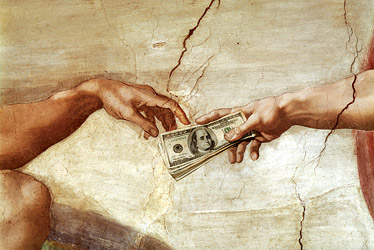
You will probably never hear me say this again, but I am glad that there are no first time visitors with us this morning. You see, the sign on the front of the church has said, “Come find the abundant life with us” for a couple of weeks now. And I believe that is what we are doing – seeking the abundant life. It comes from a promise in John 10:10, “Jesus came so that we might have life abundantly”.
For me, it was a great ‘a-ha’ moment in my faith journey when I came across Dorothy Day’s response to why she decided to give up everything to follow Christ and work in a soup kitchen for the homeless, having a non-stop routine of preparing meals and washing dishes until exhaustion. Day’s response, which you have heard me say before, was that she wanted life and she wanted it abundantly.
So, why am I glad that there are no first time visitors here this morning? Well, this week’s September 18th issue of TIME Magazine has the cover story “Does God Want You to Be Rich?”. In it, they interview a series of Prosperity Preachers who point to John 10:10 and answer with a resounding yes. God shows God’s favor by blessing you with a nice car, a McMansion, perfect health and kids with straight teeth.
And I just picture some poor unsuspecting TIME Magazine subscriber in Franklin Grove thinking to herself, well, things are a little tight around here, and I just got a Sunday School flyer in the mail from that Methodist Church promising the tools for the abundant life, and I saw on their sign the invitation to come find the abundant life with us – so, maybe I’ll give them a try.
And then I picture this poor unsuspecting soul sitting in the pews, toward the front because all of the good seats in the back are taken, listening afresh to the gospel reading this morning, and hearing “Jesus spoke plainly” about how the Son of man must undergo great suffering, and be rejected by the Pharisees, the chief priests, and the scribes, and be killed, and rise again three days later. And why? So that we could watch our football games on high-definition television? No, Jesus then goes on to say, in an equally plainly, though even more painful way, that if any want to be his followers, let them take up their cross and follow him.
Well, maybe the cross is just a metaphor for a bad habit that you need to break. You know, maybe taking up your cross is that you sleep late, or that you don’t work quite hard enough, or that you harbor too many negative thoughts. But no, although it you might sleep in too late, you might be lazy, and the devil certainly strives on negative thoughts- these are not the cross. These are little stumbling blocks on the way to righteousness. They may need to be conquered with Jesus’ help, but they are not the cross.
Jesus was not a self-help guru. Peter got it right for a change when he said to Jesus, “You are the Messiah.” And then Peter got it wrong because Jesus began to tell him something that didn’t quite gel with his conception of what a Messiah ought to do. The Messiah that Peter was hoping for in Jesus was one who would move to the front of the line. Jesus clearly had favor with God, or how else would he be able to do all of the miracles that Peter and the other disciples witnessed him doing in the previous 7 chapters? And since Jesus had God’s favor, surely he would be a king. Surely he would have a harem like David and Saul. Surely he would become wealthy beyond his wildest dreams. Surely he would have great influence over the nations.
But the truth was something different altogether, wasn’t it. Jesus did certainly have God’s favor – being the second person in the trinity and all. Jesus certainly was king. King of kings to be more exact. But Jesus did not have a harem and he did not have wealth. See, Peter had his thoughts not on divine things, but on human things. And again, Jesus was rather plain about what he had to say about that. “Get behind me Satan!” So, after his shining moment, when Peter correctly recognized that Jesus was the Messiah, it turned out that he was too much a product of the sinful and adulterous generation of his time to understand what that meant.
But actually, I think we need to cut Peter some slack. This was all so new and sudden to him. But what is our excuse? We have had 2000 years to let Jesus’ words set in. We have seen the church do works of mercy that could only be done by the people of God. But we have also seen the church lead wars for the same reason all wars are led, in the pursuit of money, land and power. Over the last 2000 years humanities greatest minds and God’s revelations have given us insight into some of the greatest mysteries of this universe, but we still exploit our neighbor. In fact, last Wednesday when we read this, we wondered if today, after 2000 years of having the truth available to us, in this day, when according to the most recent poll 95% of Americans are Christian, if maybe we aren’t an even more sinful and adulterous generation.
Beth Moore, who the Christian Moms group that Jane and Ann are a part of are studying was asked what the greatest insight she discovered while researching a book she wrote on Daniel was.
She answered, “I was struck by the parallel between ancient Babylon and today. Babylon was a spectacular city, the center of commerce, not unlike our self-absorbed, consumer-oriented culture. Isaiah 47:8 talks about the daughter of Babylon saying, "I am, and there is none beside me." That's the mindset we're surrounded by today. [One of self-absorption].
In other words, in 2000 and some odd years since Jesus gave us the truth, we are still as selfish, self-absorbed and self-possessed as we ever were.
So, two questions remain. What does it mean to take up one’s cross and how in God’s name does this lead to the abundant life?
The answer to the first question is plain, and simple, and so ridiculously hard that we can’t accomplish it on our own without the grace of God.
Jesus said, “If any want to be my followers, let them deny themselves, take up their cross and follow me. For those who want to gain their life will lose it, but those who lose their life for my sake and the sake of the gospel, will save it.”
To take up one’s cross is nothing less than to die completely to oneself. You can’t be a little bit dead. Its like that bad old joke, of the farmer marrying off his daughters, one a little bit cross-eyed and one a little bit pregnant. There are just some things that are all or nothing and apparently being a follower of Jesus is one of those things. “If any of you want to be my followers”, Jesus says, “then let them deny themselves, take up their cross and follow me.”
Next Sunday, we will have two baptisms, Daniel Alexander Devon and Jasmine Marie Coy. In baptism, we die to this world and through the work of the Holy Spirit, are born anew into the new creation. We read in the Didache, a 1900 year old book that describes how the early church did things, that people being baptized in the early church would be held under water until they began to drown. We won’t do that next week. But it really gets across the idea that after baptism, you are not just wet, you have taken part in the mystery of the resurrection. Amen?
Jesus wants all of us. All that is not holy and perfect as the Father in heaven is perfect stays on the cross. All of that is removed and in its place, we put on perfection. We put on Christ. We become the Body of Christ. That is the abundant life. Anything else that this world has to offer is peanuts in comparison. What is a Porshe when you have achieved perfection. Stuff is just relevant to the times. Think about it. How many kingdoms and jewels would Napoleon have given up for a desktop computer from the 1980’s? Today’s hot new $1000 item is yesterday’s Betamax tapes. But the power of the Lord lasts forever.
In Hebrews 13:5, we read “Keep your lives free from the love of money, and be content with what you have; for Jesus has said “I will never forsake you.”
Rick Warren, author of A Purpose Driven Life is quoted in that article I mentioned from TIME. He says,
"This idea that God wants everybody to be wealthy? There is a word for that: baloney. It's creating a false idol. You don't measure your self-worth by your net worth. I can show you millions of faithful followers of Christ who live in poverty. Why isn't everyone in the church a millionaire?"
Indeed, what would it profit you to gain the whole world, and lose your life.
The Son of Man will come in the glory of His Father and His angels. To be mistaken about that is to make the biggest mistake of all of eternity. But most of us already believe that. Most of us believe that we will die. There was a time between when I was 16 and 22 that the thought never occurred to me, but I have been cured of that. Most of us believe that there is something after death. What exactly that something looks like, we can only see through a glass darkly, because we ain’t been there yet- but the problem is not that we don’t believe that the time is coming so much as we are experienced at distracting ourselves from that time.
I have been privileged to be with several families after a loved one has died, and in every instance, there is someone, and usually most everyone, who is not only overcome with grief that their loved one has died, but is also overcome with the reality of their own death. Grief can be all that much harder when you’ve suppressed your own thoughts death. Now, healthy people do not spend each moment thinking about their mortality. That is a good thing. We got the business of life, of the abundant life for that matter, to tend to. But to completely separate your current reality from your ultimate reality – that can only be done with the help of Satan.
We have gotten so good at separating our present reality from our ultimate reality, that a nation that 95% of claims to be Christian is as sinful and adulterous as any other. We have gotten so good at separating our present reality from our ultimate reality that we allow ourselves to be comforted by any number of gadgets, gimmicks, false theologies, shysters, instead of allowing ourselves to be made uncomfortable by the word of God.
So, if you came this morning expecting prosperity theology, I am sorry. There is nothing but the Gospel here. I sometimes wish we could go down that path. It is a lot easier to tithe when you are under the assumption that you will get paid back with money plus interest. There are no such promises here. Here, tithing is a sacrificial act. A response to blessings already received instead of a down payment or a bribe for more to come.
But we do share the common faith that Jesus came to give us life, and life abundantly. Indeed, what would it profit a man to gain the whole world, and lose his life.
What is the abundant life?
That is not a question that can be answered in a sermon. I’m sorry. I know that some of you are probably thinking, we’re paying that kid a bunch of money and given his family a roof over their heads and he can’t answer the most important question that we have to ask. But I am sorry, that is the reality. You have to live the question. I can’t describe the abundant life, but I can tell you how to recognize it. The abundant life is not found at the end of a string of arguments because God is not found at the end of a string of arguments. The abundant life develops over time. It is a gift freely bestowed by The God who freely gave of The Son so that we could freely choose the abundant life. The answer is found in the living, in the working, in the celebrating, in the worshiping, in the singing, in the studying, in the sorrowing, in the struggling, and most of all in the dying of oneself, a little more each day, and the accepting of Jesus Christ as your Lord and Savior, a little more each day. The abundant life is less of me and more of Jesus. Jesus tells us, my yoke is easy and my burden is light. How easy or light depends, of course, upon how much we rely on Jesus to help us. This is the rich blessing that we are given as Christians. A Lord more precious than silver, more costly than gold, more beautiful than diamonds. Nothing that we could desire could compare to the Lord, so why do we waste our time on anything less than perfection? This is the confidence in the abundant life that answers the question of how the Dorothy Days of the world could give up everything to do hard, hard work in a kitchen day in and out and say that she had discovered life and discovered it abundantly. This is the confidence in the abundant life that could allow the Mother Theresas of the world work tirelessly for the forgotten in Calcutta. This is the confidence in the abundant life that brings the Dennys and Karens and Stans and Shirleys and Renes and all of you and me here week after week trying to get a better glimpse of God and leave a little of ourselves behind in the process.
Sisters and brothers, this is the good news this morning, let any who wish to follow Jesus deny themselves, take up their cross and follow him. Not that we have to. We don’t. Not that God is making us. God isn’t. But because we can. We are given the gift, not only of Christ’s death and resurrection, but our own as well. God loved the world so much that he gave his only begotten Son so that whosoever believeth in him shall not perish but have eternal life. Amen?
I hope that you will give me your attention just a bit longer so that I can share this poem by B.D. Prewer that really moved me this week.
Setting a cross on top of a church may be fine
but it is not discipleship.
Putting a cross on the altar is a worthy sign
but it is not discipleship.
Wearing one on a chain might seem enough
but it is not discipleship.
Getting it tattooed over one’s heart might be tough
but it is not discipleship.
Singing about the old rugged cross may feel okay
but it is not discipleship.
Preaching about the cross can point the way,
but it is not discipleship.
Weeping on Good Friday may seem devout,
but it is not discipleship.
Whipping your own back till blood flows out
is not discipleship.
Following the Christ, not counting the cost,
old bridges burning,
listening and learning,
setting your face, trusting sheer grace,
on the steep track,
not looking back,
loving and forgiving, dying while living:
that is discipleship.
B. D.Prewer 2002
Tuesday, July 11, 2006
justice pathway
[insert rants about drug companies abusing the law for their own greed here]
If this gets you mad and makes you want to get to involved in making health care available to all, than you are probably well planted on the justice pathway.
This Sunday, two days before we celebrate independence from Britain, we are celebrating this justice pathway. Those who are called and committed to the justice pathway are easy to pick out in a church. They are the ones who are always asking the questions about why we are wasting our time and money with this or that in the church when there is that or this need in the world. Often, Christians on the justice pathway are not in church for this very reason, which is a tragedy because those who aren’t plugged into a community are likely to become bitter and burnt out. But how can we better understand the justice pathway, to listen to whether the Holy Spirit is calling us down this road.
This weekend, we are celebrating the signing of the Declaration of Independence and the founding of this nation. And, despite all the lawyer jokes and whatnot, and any disparaging comments that I may make toward certain ones who work for [a certain pharmo co], – it is worth remembering that the majority of our founding fathers were lawyers or at least trained in law. And so, it is no surprise that this nation was founded on law from the very beginning. The Declaration of Independence itself reads as a legal brief. The constitution is nothing more or less than guidelines on how law in this country will work, namely how to keep balance between those who make the laws, those that interpret the laws and those that execute the laws separate. The Bill of Rights is a simple declaration saying these freedoms will be granted to our citizens by rule of law.
And so when the words justice and freedom are used in relation to people who are in this country, it is a justice that is promised by law and it is freedom secured by law. This is a good thing, because it is because of this foundation in law that this country has flourished. In addition to the ridiculous amount of natural resources that we have, it is the respect for our laws that separates us from struggling two-thirds world. As citizens in a free country, it is our responsibility to ensure that the rule of law trumps even our own personal preferences. That is, we need to defend another person’s freedom to do something that we would rather they not do. Even if it allows others to disrespect our beliefs, even if blind people remain blind because of them, even if we ourselves suffer unjustly under them as we read in Romans 12 and 13. We endure this because, without respect for the law, even for the bad laws, the whole system would collapse.
But when the words justice and freedom are used to describe the conditions of the Kingdom of God, law is not the guide. In the Kingdom of God, compassion trumps the law. Love trumps the law. Jesus knew the law. Jesus knew that according to the Levitical Law, being touched by an unclean woman or touching a corpse, would make him unclean and therefore, unfit for teaching. That these acts should be avoided at all costs by religious and holy man. But Jesus allowed the Hemorrhaging Woman to touch him and he picked up the corpse of a little girl before bringing her to life. Christ showed us that in the Kingdom of God, healing trumps the law.
It is true that, Jesus did not come to overthrow the law, but to fulfill it. Jesus worshiped in the synagogue, preached the Hebrew Scriptures, was circumcised according to the law, and did all the other rites of worship that the Hebrews did. But Jesus put the law in its proper perspective. The Sabbath serves man, the man does not serve the Sabbath is how he put it. In the Kingdom of God, the law is established so that all may receive justice. To receive justice by living in a Kingdom where nobody lacks because those that have bread share it with those that do not. A Kingdom where death and dying and mourning are no more and where war is no more because the commandments of Jesus toward reconciliation where followed. Where animosity fades away because everyone comes to trust in the wisdom of loving your enemies, even your deepest enemy that seeks to destroy you. But, living in Christ trumps living according to the letter of the law.
In the Kingdom of God, the law is established so that all may live in freedom. That we all might live in the freedom of true security that only comes from following the commandments laid down before us. But the law is the means, not the end. Compassion trumps all. Love trumps all. Justice trumps law.
When we finally allow compassion to be the primary flow of our thoughts and actions, we will be moved to doing our part to recognize the Kingdom of God on earth by seeking justice, loving kindness and walking humbly with your God.
Like all of the pathways, we are all called to partake in the justice pathway to some degree, but those shaped directly for the justice pathway serve the specific and important role of calling the church back to relevancy in the world. There’s a song that we sing around here that begins, there is peace and contentment in my Father’s house. But, then goes on to remind us that the fields need some tending. It is the burden of the woman or man on the justice pathway to shake us out of that and remind us to go work in the fields.
Within these two stories of healing that we read this morning, we see where the tension between appropriate liturgical law and life giving ministry gives. Namely, for Jesus, compassion always wins.
Jesus is passing through the crowds and he feels the touch of a woman who needed healing. She was hemorrhaging, and therefore unclean. She had plan to go unnoticed but he stops to seek her out. He seeks her out, not to rebuke her, as we may suppose, but to seek relationship with her. She reveals herself and the next thing Jesus says is ‘daughter.’ Not- hey woman, or any of the other words that we use to refer to outcasts when we are not in polite company. Jesus says daughter. Jesus is telling the crowd, and his disciples, and us if we are listening that this woman is a part of the family of God, regardless of what society may have told her. For 12 years, 12 long, horrible years, everyone had told her that she was permanently unclean. In the eyes of the men that added to God’s law, all women were unclean for at least part of the month, but for this woman, she bled for 12 years, so in a sense, she was less than human for 12 years, in their eyes. Being reminded constantly, she must have believed it in some sense. But Christ showed her that she had sacred worth because she was a daughter of God, not because of what the law said about her. Justice trumped law.
“Daughter,” Jesus says, “your faith has made you well; go in peace and be healed of your disease.” If we are going to take seriously the idea that we are the Body of Christ - that we are the hands of Jesus - then we need to follow His example. We need to seek out the poor, the marginalized, the outcasts, the unclean, the ignored, the embarrassing. We need to offer healing. We need to help awaken the desperate to the beautiful reality that the Kingdom of God actually is around us. We need to welcome them into the family. Son, daughter of Christ, you are our brother, sister. We need to affirm one another’s faith. We need to send one another off in peace.
At the base of it, this is what the spiritual path of justice is pointing us toward. You don’t have to look hard or far for injustice in this world. From oppressive regimes, to the neighbor being bullied by her husband. From sexist religions to a nation that has so much abundance and yet cannot manage to feed and give adequate health care to all of its children. From a society that only allows desirables in to a church that does not allow today’s unclean to participate fully in the community – at least not without imperfect judgments of their walk with God. From here to anywhere, you will encounter injustice.
In the Kingdom of Man, here in America, we depend upon our laws to protect us from one another, but in the Kingdom of God, the law melts away to irrelevancy because compassion wins out. We might be tempted to think that this is impossible pie in the sky sentimentality, but if we truly believe what we proclaim, that our Lord is able to heal the sick and raise the dead as we do proclaim this morning, than what is a little justice among humanity. If gone can create everything out of nothing, surely God can handle the full redemption of earth.
Once we begin to recognize the Kingdom around us, we can see how we can bear witness to that same Kingdom by loving even when it is ridiculous to love. We can have faith that our witness of love will be contagious. At twelve years of age, Jarius’ daughter in this morning’s Good News would have been considered to be at a marriageable age. She would have been able to bear children. Likewise, for the woman who was healed. We are not given her age, but she could have conceivably been in her early twenties. At any rate, they both have a life giving capacity that they didn’t have before encountering Jesus. From their life comes more life.
When the temptation comes to us to be overwhelmed by the sheer amount of injustice in the world, we can depend upon this maxim that life brings life. If we simply offer help to one than they can offer help to another and so on until our simple act has awesome consequences. It is in these concrete actions of love, not in our recitations of the law, that transformation happens. To be a Christian is not to be one who believes this or that about Christ, but one who is willing to sacrifice in order for God’s Kingdom to come and God’s will be done. In 1 John 3:17-18, we read, "How does God's love abide in anyone who has the world's goods and sees a person in need and yet refuses to help? Children, let us love not in word or speech, but in truth and action".
Listen to this observation that John Wesley made commenting on the last line of our text, “He commanded something should be given her to eat” He did this – “So that when either natural or spiritual life is restored, even by immediate miracle, all proper means are to be used in order to preserve it.” We are called to be the bearers of “all proper means”.
This fourth of July as we celebrate the Declaration of Independence, lets celebrate our interdependence in the Kingdom of God. Let us seek out injustice, and then extend ourselves to heal them, so that we might be for the world the Body of Christ redeemed by His blood.
[insert spirit led 'by all means' exhortations here]
Amen?
Saturday, January 14, 2006
Y'all come
There is a bluegrass song, popularized by Jim and Jesse in the 50's, and Jack Kelly, Jim Wolber and Banjo Bob in 2005 called Y'all Come. It would make a great theme song for the church. It starts off
When you live in the country everybody is your neighbor
On this one thing you can rely
They'll all come to see you and never ever leave you
Saying y'all come to see us by and by
Y'all come (y'all come) y'all come (y'all come) y'all come to see us when you can
Y'all come (y'all come) y'all come (y'all come) y'all come to see us now and then
When the Pharisees asked Jesus, who is our neighbor, he replied, by way of a story about a good Samaritan,
everybody is your neighbor
On this one thing you can rely
Later in his ministry here on earth, he was asked who can come to the banquet? We saw him eat with sinners and tax collectors by the dozen
And right after dinner they ain't looking any thinner
And here's what you could hear Him say
Y'all come (y'all come)...
Well, liturgically, in the life of the church, we are in the third verse.
Now grandma's a wishing they'd come out to the kitchen
And help her do the dishes right away
But they all start a leavin' grandma's a grievin' you can hear my grandma say
Y'all come (y'all come)...
Oh y'all come to see us now and then
Last Sunday, here at the church, we had a party, didn't we? Somebody say Amen. We had friends and relatives that we haven't seen ages come and join us for the awesome event- To come and see nothing - the empty tomb. People came from states around to join us the celebration of the resurrection of our Lord. Which is great. That is part of what we are here for. But, not surprisingly, only about half of us are here this week.
Last week, we were let in on the most important event in human history. We were able to share in the awe and majesty of the conquering of death... To participate in a story created before the beginning of time. A chance to sit back and marvel, and receive the awesome gift of our Lord Jesus Christ, and to get a foretaste of the feast of the heavenly banquet.
But this week, this week, the savior comes back- not to treat us to another service of celebration, another cause for a holiday to get dressed in our finest and eat and exchange gifts, but to tell us to get to work.
And now we're a wishing they'd come out to the kitchen
And help us do the dishes right away
Please turn with me to the 21st vs in the 20th chapter we read
21Jesus said to them again, 'Peace be with you. As the Father has sent me, so I send you.'
Jesus did not come back just to say hi. No, he come back to say, I have done my part to bring the Kingdom of God on earth, now it is your turn. The Father has sent me to redeem creation and I have done it. And just as he sent me, so I send you. We can imagine Jesus reminding us, hey, remember when Judas asked me a couple weeks ago 'Why was the perfume that Mary anointed me with not sold for three hundred denarii and the money given to the poor?' and I told you that "8You always have the poor with you, but you do not always have me." Well, now is the time to do unto the least of these. The time of feasting and relationship building, when I was in human form, is ended. Now is the time to feed my sheep. Now is the time to care for the poor that, in this fallen world, are always with us.
Again, vs. 22
22When he had said this, he breathed on them and said to them, 'Receive the Holy Spirit. 23If you forgive the sins of any, they are forgiven them; if you retain the sins of any, they are retained.'
This is a serious weight of responsibility. It is little wonder that our numbers have dwindled.
3If you forgive the sins of any, they are forgiven them; if you retain the sins of any, they are retained.'
"Easter is not just coming to a wonderful, inspiring worship service, it is being sent back into the (hostile) world, empowered by the Holy Spirit, to bear witness to the identity of God as revealed in Jesus." http://www.crossmarks.com/brian/john20x19e2.htm
So is this kind of a drag? Kind of like when you go out to eat with ten people and the bill is hundred dollars and each person gives you ten bucks to cover their portion and you are left with paying the $7 tax and the $20 tip. Did we stick around too long at the banquet and get stuck with the bill? Maybe it isn't so great to be given the responsibility of saving the world, of being responsible for feeding the hungry, clothing the naked, comforting the sick and binding and loosing sins.
But let us look at the promise of the text once again. Look at vs. 19, vs 21, and vs. 26. "Peace be with you." Some translations say, "My peace, I give to you." What do we get for lingering and doing the work of Christ? Not just the great story of Easter, but nothing less than genuine peace. If you could use a little more peace in your life, please say "Amen". In this text and throughout Scripture, we are promised this peace. True peace. Lasting peace. Deep peace that is not simply the absence of war and strife, but is in itself something to behold. The kind of peace that can only come from the source, from the Prince of Peace Himself, Jesus Christ.
Is it unfair to think that to whom much is given, much will be expected? I don't think so. Besides, when we are truly in ministry, and it is truly inspired with the breath of the Holy Spirit and infused with Christ's peace, there is wonder in the work and great joy in the harvest.
That is why we are
a grievin' when they all start a leavin'
Not because we are bummed that we are left with all the work. But because we know what a gift the work and the peace that comes with it is. If we truly love our neighbors, we want to get them in on the action too. We want them to receive this peace. And so we sing out with whatever voice we have...
Y'all come (y'all come) y'all come (y'all come) y'all come to see us when you can
Y'all come (y'all come) y'all come (y'all come) y'all come to see us now and then
When you live in the country everybody is your neighbor
On this one thing you can rely
They'll all come to see you and never ever leave you
Saying y'all come to see us by and by
Y'all come (y'all come) y'all come (y'all come) y'all come to see us when you can
Y'all come (y'all come) y'all come (y'all come) y'all come to see us now and then
When the Pharisees asked Jesus, who is our neighbor, he replied, by way of a story about a good Samaritan,
everybody is your neighbor
On this one thing you can rely
Later in his ministry here on earth, he was asked who can come to the banquet? We saw him eat with sinners and tax collectors by the dozen
And right after dinner they ain't looking any thinner
And here's what you could hear Him say
Y'all come (y'all come)...
Well, liturgically, in the life of the church, we are in the third verse.
Now grandma's a wishing they'd come out to the kitchen
And help her do the dishes right away
But they all start a leavin' grandma's a grievin' you can hear my grandma say
Y'all come (y'all come)...
Oh y'all come to see us now and then
Last Sunday, here at the church, we had a party, didn't we? Somebody say Amen. We had friends and relatives that we haven't seen ages come and join us for the awesome event- To come and see nothing - the empty tomb. People came from states around to join us the celebration of the resurrection of our Lord. Which is great. That is part of what we are here for. But, not surprisingly, only about half of us are here this week.
Last week, we were let in on the most important event in human history. We were able to share in the awe and majesty of the conquering of death... To participate in a story created before the beginning of time. A chance to sit back and marvel, and receive the awesome gift of our Lord Jesus Christ, and to get a foretaste of the feast of the heavenly banquet.
But this week, this week, the savior comes back- not to treat us to another service of celebration, another cause for a holiday to get dressed in our finest and eat and exchange gifts, but to tell us to get to work.
And now we're a wishing they'd come out to the kitchen
And help us do the dishes right away
Please turn with me to the 21st vs in the 20th chapter we read
21Jesus said to them again, 'Peace be with you. As the Father has sent me, so I send you.'
Jesus did not come back just to say hi. No, he come back to say, I have done my part to bring the Kingdom of God on earth, now it is your turn. The Father has sent me to redeem creation and I have done it. And just as he sent me, so I send you. We can imagine Jesus reminding us, hey, remember when Judas asked me a couple weeks ago 'Why was the perfume that Mary anointed me with not sold for three hundred denarii and the money given to the poor?' and I told you that "8You always have the poor with you, but you do not always have me." Well, now is the time to do unto the least of these. The time of feasting and relationship building, when I was in human form, is ended. Now is the time to feed my sheep. Now is the time to care for the poor that, in this fallen world, are always with us.
Again, vs. 22
22When he had said this, he breathed on them and said to them, 'Receive the Holy Spirit. 23If you forgive the sins of any, they are forgiven them; if you retain the sins of any, they are retained.'
This is a serious weight of responsibility. It is little wonder that our numbers have dwindled.
3If you forgive the sins of any, they are forgiven them; if you retain the sins of any, they are retained.'
"Easter is not just coming to a wonderful, inspiring worship service, it is being sent back into the (hostile) world, empowered by the Holy Spirit, to bear witness to the identity of God as revealed in Jesus." http://www.crossmarks.com/brian/john20x19e2.htm
So is this kind of a drag? Kind of like when you go out to eat with ten people and the bill is hundred dollars and each person gives you ten bucks to cover their portion and you are left with paying the $7 tax and the $20 tip. Did we stick around too long at the banquet and get stuck with the bill? Maybe it isn't so great to be given the responsibility of saving the world, of being responsible for feeding the hungry, clothing the naked, comforting the sick and binding and loosing sins.
But let us look at the promise of the text once again. Look at vs. 19, vs 21, and vs. 26. "Peace be with you." Some translations say, "My peace, I give to you." What do we get for lingering and doing the work of Christ? Not just the great story of Easter, but nothing less than genuine peace. If you could use a little more peace in your life, please say "Amen". In this text and throughout Scripture, we are promised this peace. True peace. Lasting peace. Deep peace that is not simply the absence of war and strife, but is in itself something to behold. The kind of peace that can only come from the source, from the Prince of Peace Himself, Jesus Christ.
Is it unfair to think that to whom much is given, much will be expected? I don't think so. Besides, when we are truly in ministry, and it is truly inspired with the breath of the Holy Spirit and infused with Christ's peace, there is wonder in the work and great joy in the harvest.
That is why we are
a grievin' when they all start a leavin'
Not because we are bummed that we are left with all the work. But because we know what a gift the work and the peace that comes with it is. If we truly love our neighbors, we want to get them in on the action too. We want them to receive this peace. And so we sing out with whatever voice we have...
Y'all come (y'all come) y'all come (y'all come) y'all come to see us when you can
Y'all come (y'all come) y'all come (y'all come) y'all come to see us now and then
Wednesday, January 04, 2006
curricula vitae
Garrett-Evangelical Theological Seminary
B.A. Dominican University, River Forest, IL, May 2001
Major: Philosophy Cumulative GPA: 3.6/4.0
Minor: Pastoral Ministry Major GPA: 3.9 (Cum Laude)
President of Phi Sigma Tau (Philosophy Honor Society)
A.A. College of DuPage, Glen Ellyn, IL
Canterbury Christ Church College, England Debate Team
EXPERIENCE Franklin Grove UMC Franklin Grove, IL July 1, 2004 - present
Licensed Local Pastor
Irving Park United Methodist Church, Chicago, IL 2002 - 2004
Student Associate Pastor
*Frequent sermon deliveries, pastoral care/visits, sextant
Community United Methodist Church, Brookfield, IL 1998 - 2002
Liturgist
*Lay leader to annual conference
*Frequent sermon deliveries, Co-creator of liturgy
Youth Pastor Summer 1998 - 2001
*Organized Vacation Bible School curriculum
*Worked with confirmands to organize service trips
VOLUNTEER Kreider Services, Dixon, IL October 2005 - current
*Client Advocate for mentally challenged individuals
*Contribute to policymaking for the Advocacy and Rights Advisory Council
Helping Hand Rehabilitation Center, Countryside, IL February 2002 - 2004
*Client Advocate for mentally challenged individuals
*Contribute to policymaking for the Advocacy and Rights Advisory Council
Thomas Hughes Children Library at HWL, Chicago, IL Summer 2001, 2002
*Volunteered four hours a week assisting children to read
ADDITIONAL Hon. William Young Boston, MA Summer 2003
WORK *Christian ethical advisor
EXPERIENCES
Garrett-Evangelical Library, Evanston, IL October 2001 – May 2002
*Book binder and restorer
Brookfield Financial Plans, Brookfield, IL February 1998 – April 2002
*Created financial planning portfolios
*Checked tax returns
Subscribe to:
Posts (Atom)